Monday, September 13, 2010

Vegan Blue Posole by Candlelight

Hello darkness my old friend. I’ve come to dine with you again.

I'll be the first to admit this is not the most attractive soup. On the ugly soup meter, it scores about an 8.5. But it's so tasty, in a dimly lit room, who's going to judge? Trust me, it's the most wonderful, earthy dish you won't want anyone to see. When you bite into that vibrant, chewy New Mexican maize, you'll see how amazing it is. Plus, you and your insatiable soup-loving significant other can both go back for thirds and the other one won't have to know. A dark room, two pigs and a pot of posole. Now that's my idea of a romantic dinner.

But before you call the grease police on me, I must tell you this only looks greasy. Believe me—I'm not into big oil. If you think I want BP getting its greedy, greasy paws in my posole, you're grossly mistaken. I kept big agro out of it too, by making it vegan, adapting the recipe from the package of posole that I got at the Santa Fe School of Cooking when I visited there (you can buy it here). I cut the heat by only using half the chile powder it called for ('cause I'm a wuss that way), but I added cumin seeds for extra flavor. I used vegetable broth instead of chicken broth, and I substituted olive oil for canola. And when the broth and the oil met that glorious chile powder I got in Chimayó, they all turned an irridescent orange. Sure, it may look like Chernobyl, but it tastes like Chimayó. And that's the important thing, right? That, and you won’t have to do your hair and makeup for dinner.

Recipe

¾ pound (2 ½) cups) posole, picked over for any dirt or stones

3 TBSP olive oil (you can use less if you want to eat in broad daylight)

1 ¼ cup chopped onions

1 TBSP minced garlic

1 - 2 TBSP pure ground Chimayó style red chile powder (start with less and add more if you need to)

4 cups vegetable stock

1 teaspoon toasted and freshly ground coriander seeds

1 teaspoon toasted cumin seeds

salt to taste

½ cup coarsely chopped cilantro*

Place cleaned posole in a large pot and cover with cold water by 3 inches. Cover and simmer for 2 to 3 hours, adding water as needed until kernels are soft and beginning to burst. Drain and rinse well. Heat oil in a large pot and sauté the onions until golden. Add the garlic and sauté for 1 minute. Add the posole, chile powder, stock, ground coriander and cumin and ¼ cup of the cilantro and simmer for 30 minutes. Add the salt and continue cooking for 30 minutes. Stir in remaining cilantro, taste and adjust seasonings.

*D'oh! I forgot the cilantro!

Serves 4 - 8, depending on how dark the room is.

Friday, September 10, 2010

Chillin' with the Chiles in Taos: Part 3

After finding God in a chile relleno in Chimayó, my mojo was working again. Now I was ready for the Taos blues: blue skies and blue corn. Maybe even some blue posole if I got lucky. I finally found some alone time walking the sleepy streets the next morning, and a glorious Bent Street Cafe breakfast of huevos rancheros with scrambled eggs, blue corn tortillas, fresh green chiles, cheddar cheese and refried beans bestowed their curative powers on me much like the relleno had. What a difference a chile makes. My grief over Howard had subsided as I embraced the wide open space with a lighter heart and heavier stomach.

During breakfast the next day at Michael's Kitchen, I had but one question: "Atole-piñon pancakes, where have you been all my life?" These indigenous Southwestern hotcakes were made with earthy, blue cornmeal and roasted local piñon nuts in the batter. They were like piñon-packed piñatas—nuts falling out with every blow of my fork. I've made blue cornmeal pancakes before, and they were a murky, dark blue-gray color. But these beauties were golden brown on the outside with only a hint of blue-gray on the inside.

I asked the waiter, who might have been a farmer, what was in the batter, and he just shrugged. "How do I know? Go ask the cook," he said, motioning me to go to the kitchen. So I walked over there, stuck my head in the window and said, "What's in your piñon pancake batter?" The cook looked up, surprised at my gumption, and said "Half pancake mix and half blue cornmeal." Aha! A trade secret revealed straight from the horse's mouth. (I wonder if Thomas Keller would oblige me in the same fashion at the French Laundry.)

New Mexico is renowned for its piñon nut, a name derived from the Spanish word for pine nut. The piñon pine tree is a two-needled pine which grows wild in the high desert mountains. Out of the 100 recognized species of true pines, only a few produce nuts that are worth eating. The piñon is smaller with a smoother, more delicate flavor than the ones we use in the rest of the country. Pignolias from Italy are supposedly the closest in flavor to piñons, but these days, a lot of the pine nuts are coming from China. The bag I got at Trader Joe's says they're either from Russia or Korea. Unfortunately, most of these imports are overly intense and astringent, unlike the subtle and creamy piñon, which is far superior. But hey, that's just my 'pinion.

About five miles outside of Taos is the Rio Grande Gorge Bridge—the second highest suspension bridge in the country. Needless to say, the view of the gorge is gorgeous. And while you're in the neighborhood, you can do a little emu oil shopping. The emu experts claim the oil from this ostrich-like bird offers arthritis pain relief, calms psoriasis and eczema, increases hair growth, regenerates skin cells and more. But as far as healing powers go, I'm standing by my chile theory.

After spending a couple of nights in Taos and conquering a few breakfasts on my own, I was feeling healthier. I had felt the powers of the chile and knew I could face the world again with the strength of a Habanero. It was time to head back to Santa Fe, and with less than 24 hours left on the trip, I still had posole to buy and farmers to meet. I would be spending those final few Saturday hours at the grand daddy of farmer's markets. And it was gonna be good.

Related Posts:

Monday, September 6, 2010

Chillin' with the Chiles in Chimayó: Part 2


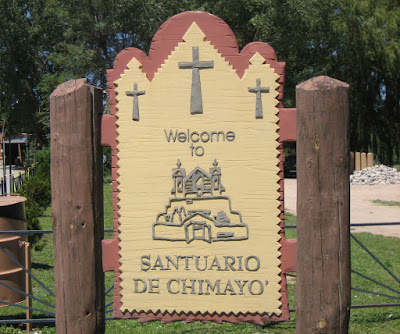
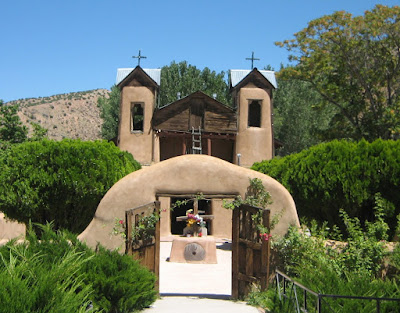
I had been in New Mexico for three days, 19 hours and 27 minutes and had yet to eat a chile relleno. But on day four, destiny called. My aunt and I were off to Taos, and our first stop was the town of Chimayó. This tiny village in the Sangre de Cristo Mountains on the high road to Taos is known for two things—the best chiles in the country and an old sanctuary purported to have healing powers. In fact, so many pilgrims walk to El Santuario de Chimayó each year, it’s referred to as the Lourdes of America. If you ask me, you’d have a better chance of being healed by the chiles, with all their vitamin C. But that’s not as romantic as a chapel full of holy dirt and crutches that were supposedly left behind by those who were miraculously cured. Call me a spiritual killjoy, but I’m standing by my chile theory.

The legendary Chimayó chile is a Native American heirloom strain that’s been growing for about 400 years solely in Northern New Mexico. It has a distinct pottery red-orange color and a deep, robust flavor that’s superior to the hybrid commodity chile grown in Southern New Mexico, like Hatch and Socorro. Its supremacy is due to the region’s optimal growing conditions and the chile’s natural adaptation to it, which has created a more disease-resistant crop and can grow without fertilizers. Since Chimayó chile powder sells for about $20 for four ounces, big agribusiness and identity thieves are hot to brand their chiles as Chimayó. Hence, they genetically modify crops and engineer flavors, which threaten the survival of the native seed strains.

The Chimayó chile was nearly extinct a few years ago since only a handful of farmers were still growing it. Then a consortium of farmers and activists started the Chimayó Chile Project to protect the native crop and the farmers’ intellectual property. They started with seed preservation and then began working with the local farmers. In 2006, the Native Hispanic Institute helped provide the farmers with legal and technical assistance so they could incorporate and apply for the trade name Chimayó. Today it’s a registered mark owned by Chimayó Chile Farmers, Inc.

We stopped in a little store (above) called El Potrero Trading Post to buy some chile powder. They told me they didn't have the real Chimayó heirloom variety since it was only available for two months, in October and November. They assured me, however, that the quality of the type I got was very close. It was so fresh and fragrant—far superior to any chile powder I’d ever smelled. How could the real stuff be that much better?

It was finally time for our highly anticipated lunch at the Rancho de Chimayó, a charming restaurant in a century-old adobe hacienda surrounded by three mountain ranges. Our sunny patio table overlooking the handsome terrain and azure sky was a vivid setting for my moment of truth. Would this be the life-affirming chile relleno I'd been waiting for or would I give it all up to become a culinary nun? Would a case of sour grapes lead me down a dark, eat-to-live path devoid of all decadence and rapture?

As the first bite of relleno kissed my lips, I heard a ringing in my ears: Hal-uh-loo-ya. As it gracefully slid off the fork and onto my tongue, my mouth heard it too: Hal-uh-loo-ya. Hal-uh-loooooo-ya. Hal-uh-loooooo-oooooo-ya! That green chile was so fresh, it was practically still on the vine. I was convinced that whoever had the divine vision in 16th- century Mexico to take a fresh green chile and roast it, stuff it with cheese, dredge it in an egg batter, fry it to golden-hued perfection and top it with fresh, chopped tomatoes should have a sanctuary built in his or her honor. And whoever had the vision in 21st-century New Mexico to serve it with Spanish rice, white posole and fresh sopapillas for $7.25 deserved some kind of shrine. I was cured. I was a believer. And it was well worth the pilgrimage.

Related Posts:

Tuesday, August 31, 2010

Chillin' with the Chiles in Santa Fe: Part 1

While grieving the death of my old friend Howard, an opportunity arose for me to meet my anthropologist aunt in Santa Fe and stay in a house she had for the week. Seemed like the perfect chance for some wide open space to regain my bearings, ditch my blog for my private journal and eat some homegrown New Mexican food. “You’ve been wanting to go back there for a while,” I told myself. “No obsessing over every pixel-packed pronouncement on Trip Advisor. Just go! Even though you won’t be alone, you’ll find some alone time.”

The last time I was there was with Howard 20 years ago, and a little roadrunner told me I would feel his spirit all around me. Howard was so talented, he used to bang out pieces of Southwestern furniture like he was sneezing. He also made jewelry, was a photographer and architect, but in later years, he mostly painted landscapes. Sure enough, on day one, I felt his spirit all around me. By day four, it had turned into a constant heartache. “Grieving is good,” I told myself. “You’ll write it all down and have fodder for your novel about Howard.” Yet somehow my thoughts were not being journaled, no good meals had graced my stomach lining, and that alone time had devolved into energy-zapping compromises.

Usually at a time of distress, I lose my appetite. But this time, I was counting on food to pull me out of the abyss. I ended up reading all about the Santa Fe restaurant scene, cramming online menus as if Griddled Buttermilk Corn Cakes with Chipotle Prawns and Peppery Elk Tenderloin were going to be on my SATs (turns out me not obsessing is about as likely as Tiger Woods not screwing a porn star). I knew the difference between the Coyote Café’s dinner offerings and their cheaper cantina menu. Pasquale’s was going to be hard to get into, but their Smoked Trout Hash sounded like it might be worth the wait. Unfortunately there were major crowds in town for the annual Indian market, and my aunt was on an odd, non-negotiable schedule which did not include any dinners out, so I couldn't get my restaurant mojo working. I was so close, yet so far away to posole, green chile stew, blue corn enchiladas, the freshest chile rellenos on the planet, and a slew of farm-to-table offerings.

Why can’t I eat a nice meal in a restaurant alone? Not only do I feel self-conscious, there's no one to share the culinary conversation with. Who would be graced with my blow-by-blow account of each bite in real time? I can go to a coffee house or some quick cafe type of place, but when it comes to a real sit-down restaurant, I just can't do it. I conquered this quirk somewhat on my trip to Turkey, but I wasn't able to this time. All the good places to go were the ones I wasn't going to.

On my way to the folk art museum, I stopped at the Tuesday Santa Fe farmer's market by the railroad tracks to quickly check it out. I had heard Saturday is the day to go, but I couldn't resist getting a sneak preview. There were mountains of fresh chilies, a rainbow of unusual eggplants, squashes and heirloom tomatoes. There were charming bouquets and ornamental wreaths made out of sage, dried flowers and chiles. Artisan soaps, spices, garlic oil, jams and breads abounded. I talked to the farmers, tasted their peaches and took their photos. Suddenly I breathed new air. I had been to museums, galleries, shops, monuments, and the Indian market, but it wasn't till then that I felt my mojo working. I couldn't wait till Saturday.

Rather than eat alone somewhere, I opted to grab a quick bite while I was at the museum. What sounded like a lovely lunch of orzo salad with edamame and curried lentils turned into the two most dreadfully seasoned dishes ever. What was that sour taste in both of them? How could such nice ingredients be so horribly bastardized? I gazed around me. Everyone else's food looked really good. It just happened that mine was inedible. I would have sent it back, but I fell short in the cahones department. I slunk back into my funk. Why couldn't I catch a culinary break? Then I realized when half of Pakistan was under water, I had a lot of chutzpah (aha, I do have cahones!) to be feeling sorry for my epicurean-starved self.

Besides, we were headed for Taos the next day, and my fingers and toes were all crossed for edible nirvana. We’d be stopping in the town of Chimayó on the way—a village on the high road that's renowned for growing the best red chiles in the world. We had lunch reservations at the Rancho de Chimayó. Posole, green chile stew, blue corn enchiladas and the freshest chile rellenos on the planet: here I come. I was going to have a killer meal if it killed me.

Related Posts:

Wednesday, August 18, 2010

Ode to an App


Sure, the iPhone can compute

A BlackBerry is one smart fruit

But killer apps are at a loss

For making killer applesauce

Thursday, August 12, 2010

Travel Bite: Street Snacks, Mexico City


When I visited Mexico City a few years ago, I stayed in the historic city center within walking distance of the main square or zócalo, called Plaza de la Constitución. This photo of the Catedral Metropolitan de la Asunción de María (Metropolitan Cathedral) was taken from a good distance away, so you can't really fathom how huge it is. It's the largest (and oldest) in all of the Americas. Trust me, it can hold a lot of prayers.


Across the street from the cathedral is the National Palace or Palacio Nacional (the building in the background) with government offices of the president, the Federal Treasury and the National Archives. It's been a palace for the ruling class of Mexico since the Aztec empire. I think the jugo de naranja (orange juice) vendor may have been a more recent arrival.


On the zócalo and the surrounding streets are vendors of all stripes. And yes, hot sauce does belong on the potato chip, in case you were wondering. Why buy nacho-flavored when you can make your own?

Chicharrón, or pork rhinds to us, are a popular snack. Made from pig skin that's rendered, dried, and then fried, I can proudly say that for once, I was not tempted to pig out. I wrote that day down in my journal for posterity.


As you can see, these chips are a big nod to American capitalistic ingenuity—fried, salty, thirst-inducing snacks with bright orange food coloring. How do you say Cheetos en Español?


Fresh ears of corn are grilled, de-cobbed, and griddled before your very eyes. Along with squash and beans, corn was one of the three earliest plants domesticated in the Western hemisphere. I think the coca-cola plant was the fourth.


Different varieties of peanuts and pumpkin seeds or pepitas are a ubiquitous offering. Peanuts are said to have originated in Peru, and the Spanish conquistadors brought them to Mexico. Pepitas have been here since the time of the Aztecs or earlier. They're not only a popular snack, they are the main ingredient in mole pipián—a nutty, herby, green sauce.


These makeshift juice stands are clearly for the locals and not gringas like me. I ordered all my drinks sin huelo (without ice). How do you say Kaopectate en Español?


This is the only agua I would be drinking. And just in time with all those salty snacks. (I didn't really eat any, but it made for a good ending.)

Saturday, August 7, 2010

Roasted Eggplant Spread on Polenta Rounds


Sure, it’s more fun to say Baba Ganoush, but you’ll get over it.
Since it’s technically not Baba Ganoush without tahini, this is simply called Roasted Eggplant Spread. But who needs tahini when you’ve got all these luscious roasted veggies? Granted, if it were up to me, I’d call it Bubba Ganoush since I’m from Texas. But then I already covered that in my last post.

This earthy-sweet spread is essentially roasted eggplant, red peppers, red onion and garlic that you put in a food processor with a dab of tomato paste. The easy, hard-to-screw-up Ina Garten recipe never fails to please both me and a crowd. And judging by how many servings I can eat, sometimes I am the crowd. (I'm thinking my portion-control issues may stem from a traumatic childhood math test. Yeah, let’s go with that.)

I usually serve this spread with my Cheater’s Lavash Crackers, but for an L.A. food blogger's meet-up, I got all show-offey ambitious and presented it on round pillows of polenta. You can see my stiff competition here at the terrific blog, Cook and Be Merry.

I would avoid buying those packaged tubes of polenta since they don't taste very fresh, and it's easy enough to make your own rounds. I formed these with a biscuit cutter, but the clever Andrea, of Fork, Fingers, Chopsticks, shows you how to make your own tube in a can. I actually kind of enjoyed this biscuit-cutter polenta activity. In fact, it was only a corn cob away from being fun. But then I don’t get out of the kitchen much.

Eggplant Recipe (by Ina Garten)

1 medium eggplant

2 red bell peppers, seeded

1 red onion, peeled

2 garlic cloves, minced

3 tablespoons good olive oil

1 ½ teaspoons kosher salt

½ teaspoon freshly ground black pepper

1 tablespoon tomato paste

Fresh basil leaves and pine nuts for garnish (my personal addition)

Preheat the oven to 400 degrees F. Cut the eggplant, bell pepper, and onion into 1-inch cubes. Toss them in a large bowl with the garlic olive oil, salt, and pepper. Spread them on a baking sheet. Roast for 45 minutes until the vegetables are lightly browned and soft, tossing once during cooking. Cool slightly.

Place the vegetables in a food processor fitted with a steel blade, add the tomato paste, and pulse 3 or 4 times to blend. Taste for salt and pepper.

Yield 6 to 8 servings

Polenta Rounds

8 cups water

2 teaspoons salt

2 cups polenta

3 tablespoons butter

½ cup of asiago cheese

In a heavy saucepan, bring water and salt to a boil and gradually whisk in cornmeal. Cook over moderately low heat, stirring constantly, until very thick, about 15 minutes. Towards the end, add the butter and cheese. When melted, pour polenta into a 9 x 13 glass pan so the polenta is about 1 ½ - 2 inches deep. There will still be more polenta left, so put the rest in a smaller pan (just eyeball one that will fit). Let polenta cool completely, then refrigerate until firm.

Using a 2 ½-inch biscuit cutter, cut out rounds (try to maximize the number by cutting them out close to each other). Place the rounds in a 400º oven and bake until firmer and a bit crunchy. The refrigeration and oven steps are optional if you want a softer polenta and to serve it sooner. It can be served warm or at room temperature. Garnish each polenta and eggplant round with a small basil leaf and a couple of pine nuts.

Makes 20+ rounds with spread. (In other words, there's polenty to go a round.)


Monday, August 2, 2010

My Chelsea Clinton Wedding Menu

An Introduction to HillBilly Kosher Cuisine.
At the celebrity wedding of the year, Chelsea Clinton—daughter of Hillary and Bill—married longtime beau Marc Mezvinski. The Methodist Arkansas bride and Jewish groom inspired me to create a new culinary fusion—HillBilly kosher (Think Tex-Mex, but with a yarmulke instead of a sombrero). As a Texas Jew, I felt uniquely qualified to create a menu that would satisfy both sides of the aisle.

Wine List

2012 Chateau You Never Take Me Anywhere This marriage varietal whine will not reach its peak until a few years after the wedding.

2010 Little Rock Vineyards, Cousin’s Blush A whole family of grapes intermarried in a single oak barrel

2009 Arkansas Sparkling All-White Wine This discriminating white has a pronounced racial profile.

Well Drinks

The Hava Nagila, Have a Tequila Cuervo Gold and seltzer served in an antique silver goblet with a Rolaids garnish

Appetizers

Bubba Ganoush Eggplant that’s been smoked in a foil packet in a car engine, mixed with tahini

Chicken-Fried Chopped Liver Mounds of chopped liver, dredged in flour and fried to a crunchy finish

Pickled Catfish Marinated catfish in vinegar and pickling spices, served with a whisker garnish

First Courses

Fried Chicken Soup A fried chicken leg resting on a matzo ball pillow in chicken broth

Biscuits and Lox and Gravy Buttermilk biscuits cut in half with lox, capers, tomato and red onion, smothered in gravy

Entrées

Deep-fried Gefilte Fish Ground carp, whitefish and pike mixed with matzo meal and egg, simmered in stock, then cooked in a deep fryer for a gefilte-fish crunch

Chicken-fried Brisket Bubbie’s brisket served Bubba-style, pounded and breaded to pan-fried perfection

Corned Beef on Cornbread New York deli-style corned beef served between two pieces of cornbread with a vibrant mustard butter

Shabbat Roasted Chicken on Collard Greens A quarter of a Sabbath chicken bathed and roasted in an Ashkenazi spice rub, served on a bed of collard greens that have been simmered in a pareve chitlin consommé

Sides

Macaroni and Cheese Kugel Velveeta and wide egg noodles topped with dried challah crumbs and baked until golden brown

Candied Yam Latkes Grated yams baked in brown sugar and butter, topped with marshmallows, then fried in patties

Black-eyed Peas with Kosher Ham Hocks The favorite Southern legume simmered in a smoky broth with special rabbi-ordained ham hocks

Dessert

Jewish Apple Wedding Cake with Fried Twinkie Ladyfingers The traditional Jewish apple cake is transformed into a multi-layered, monolithic white cake with Crisco frosting, surrounded by deep-fried Hostess Twinkie ladyfingers

Although the bride is vegan and probably ordered a special macrobiotic meal, I’m sure the guests would have enjoyed this cross-cultural culinary journey. Congratulations to Chelsea and Marc, and may there be many more HillBilly kosher meals in their future.