Tuesday, May 12, 2015

Fashionista Farmer: Santa Fe Print Edition, Part 2


If you saw my post from the Santa Fe Farmers’ Market featuring prints charming, then you must be chomping at the bit to meet the Royals. What constitutes fashionista-farmer royalty? Is it organic, fair-trade, non-GMO, gluten-free, cruelty-free, rainforest alliance certifications? Nice try, but no. The farmers must simply display their wares with artistic flair, a sense of style and be farmstand eye candy. And for bonus points, their clothing must be color-coordinated with their products. Yep, I make the rules around here, and that’s what constitutes fashionista-farmer royalty. If you beg to differ, please take it up with the authorities by filing a formal complaint at the Bureau of Fashionista Farmers. In the meantime, eye some candy.

Mixed Greens and 50 Shades of Gray
Both provocative and high in folate, the man in gray and his matching ensemble was Prints Charming-certified.


Salve-y Lady 
This herbal salve seller rubbed me the right way with her originality.


Chimayo Red-hot Couture 
His clothing may have been half-baked, but his shades, hat and tablecloth provided the sizzle—along with the chile, natch.

Multi-hued Hot Couture Ensemble
Between her chile print apron and his hot, red shirt, they proved to be worthy chile-istas.


Earth Mother Ensemble
Her sage wisdom shone through with a retro, herbal-forward sensibility.


Karl Lavender Field
His many products went on like lavender fields forever. He even grew his own shirt. 


Aqua and Taupe Scone Ensemble, Sans Gluten
In addition to baking gluten-free, she gets bonus points for her fully baked color vision.


Beet Scone Ensemble, Sans Gluten
She also gets bonus points for matching. I hope the scones taste as good as the ensemble looks.


Hemp-glassed Baker, Sans Hemp
I didn't see hemp listed as an ingredient, but he still gets points for his whacky vision.


Batik Chic Baker 
What a pleasing pastry presentation, down to his coordinated shirt. Kudos, baker dude!


Cafe Accompaniment in Pink
He even matched the bacon, but regrettably, not the breakfast burrito. 

Which is your favorite fashionista farmer?

Related Links:

Thursday, April 30, 2015

Fashionista Farmer: Santa Fe Print Edition


You think I care that New Mexican farmers think I'm a stalker? That's the price you pay for being a Santa Fe Farmers' Market "enthusiast." It’s been three years since I was there last, and the thrill never gets old. Is it because these homegrown purists practice organic, sustainable agriculture the way their foremothers did? Check. And because everything is hyper-local and unique to the area? Yup. And that they spit in the face of Monsanto and Big Chemical? Yessiree. But New Mexican farmers also have an eye for color and composition that puts other markets to shame. So I’m showcasing some of the print backdrops upon which they so artfully display their wares. And the designers, I mean farmers, are pretty colorful too. But you'll discover that in Part 2. In the meantime, meet prints charming.

Hot couture (chile powders) and dried jujubes (bottom)
Flower power (chévre with edible flowers)
Lavender fields forever
Chocolate, red chile, toffee bacon donuts


Gluten-free beet and apple scones; GF blue corn, green chile and chévre scones


Goat milk soaps; sage and wormword sticks

If you liked meeting the prints, just wait till you meet some of the farmers in Part 2.


Related Links:

Wednesday, January 7, 2015

Ode To Maters


Today I am an heirloom
My skin so cragged and crinkled
The one who stole my cherry?
Now even he is wrinkled

Wednesday, December 31, 2014

6 Smart Food Trends to Watch in 2015


Labels that tell you whether the water's been fracked? No, not really, but I have some real predictions for six food trends to watch in 2015.


This article originally appeared on Zester Daily and MSN Food & Drink.


This year not only beckoned all things local, organic and sustainable, it begged for transparency in our food supply. From growing concerns about GMOs and factory farming to the films “Fed Up” and “Food Chains,” people may finally be waking up to the fact that our food system is as much political machinery as tractors and plows.

Here are six developments that prove consumers want more healthy, sustainable and humane options. 

1. Organically growing
Once thought of as a niche movement for flower children and pretentious yupsters, organics is now as marketable as Taylor Swift. With 81% of U.S. families choosing organic food at least sometimes—and restaurants, food companies and grocery stores acquiescing to customer demand—it comprises about 4% of food sales in the U.S. (about $38 billion). Sales of organic products at Costco have doubled in the last two years (to about $3 billion a year), and Walmart is promising to sell organics at the same price as conventional food through an arrangement with Wild Oats. Where will all this new organic food come from? Will the industrial-scale Walmartization of organics weaken organic standards and squeeze out the family farmers who helped commercialize the movement? There are already storm clouds on that horizon. 

2. Non-GMO labeling
As consumers are getting hip to Big Food’s genetically engineered ways, the majority of Americans want GMO labeling. But as the big chemical and food companies continue to dump millions into defeating state labeling initiatives, smaller food companies and restaurants are taking matters into their own hands by touting non-GMO ingredients. In fact, Non-GMO Project verification may be the future for GMO labeling. In November, not only was Colorado’s Prop 105 defeated, Oregon’s Measure 92 was so close, there was a Bush-Gore-style recount before being shut down over a technicality. Vermont is the only state that has successfully passed a labeling law, but it could be held up for years by appeals. Not to mention anti-labelist, corporate-backed politicians have introduced H.R. 4432, a bill that would prevent states’ rights to have mandatory food labeling and would also prevent the FDA from creating a national GMO labeling standard.
But you can’t put the pesticide genie back in the Roundup bottle. The more these companies try to hide what’s in our food, the more we want to know.

3. Locally sourced 
People not only want to know what’s in their food, they want to know the chicken’s middle name and the arugula’s forwarding address. This new farm-curious mentality stems from the rise of farmers’ markets all over the country that’s fostering familial, Main-Street communities. USDA data shows the continued growth of farmers’ markets for every region in the country. Five of the states with the most growth were in the South—Tennessee, Louisiana, Texas, Arkansas, and North Carolina. Since this region has some of the highest obesity and poverty rates in the U.S., success here is great news. Community-supported agriculture (CSA) farms are also on the rise, including community seafood that sells sustainable seafood directly from local fishermen to consumers. Expect more artisanal companies to crop up, as well as restaurants touting their chickens’ favorite bedtime lullabies. 

4. Vegan and Gluten-free Menu Items
Restaurants jumped on the “V” and “GF” bandwagons, kowtowing to the cow-less and wheat-less among us—not simply to indulge the trendier-than-thou set. People with real food sensitivities want dishes that are safer than thou. Restaurants are getting serious about allergen training and many have separate menus for top allergens in order to mitigate potential emergency room visits and even fatalities. By law, Massachusetts and Rhode Island require restaurants to provide allergen training to their employees, and similar laws will probably appear in other states or even at the federal level. That way, diners will be less litigious than thou.

5. Dairy-free milks
Many conscious Americans are swapping cow’s milk for plant-based alternatives, and almond milk beats out soy, rice and coconut by a wide margin. However, 80% of the world’s almonds are produced in drought-afflicted California, and 10 percent of California’s water goes to almond farming (it takes 1.1 gallons of water to grow a single almond), so where does that leave almonds on the sustainability meter? Hazelnuts from Oregon could be poised to respond to the nut milk demand. Oregon grows 99% of the country’s hazelnuts, which use less water, are drought-resistant and can thrive with minimal maintenance. Some high-end café owners actually prefer the taste and are already asking is hazelnut milk the new almond milk

6. Pasture-raised meats and grass-fed beef
As consumers are getting savvier about factory-farmed animals that eat GMO grains, we’re seeing more pasture- and grass-fed meats at farmers’ markets from small producers. Grass-fed and grass-finished beef are seeing a greater share of the consumer beef market, and larger producers are selling through chain grocery stores and restaurants. Steve Ells, CEO of Chipotle, says “Over time, we hope that our demand for grass-fed beef will help pave the way for more American ranchers to adopt a grass-fed program, and in doing so turn grass-fed beef from a niche to a mainstream product… Most of the U.S. grass-fed beef that meets our standards is simply not produced in sufficient quantities to meet our demand. That's why we want to encourage more American ranchers to make the transition to raising cattle entirely on grass.”


Saturday, December 20, 2014

Happy Farm-to-table Holidays!


Have a latke-licious Chanukah, and don't skimp on the onions! 

May the season bring warmth to all your chilly days.

Here's wishing you a bounty of beautiful farm-fresh food. 


With gratitude to farmers and farmworkers everywhere, happy holidays from the bottom of my farmers' market bag.
—LB

Sunday, November 23, 2014

10 Farm-to-table Centerpieces


You can tell a lot about a person from their table's centerpiece. Mine says I have an eco-chic sensibility. Think hippie chick with a fine art degree and a razor. I did say chic. To me, a bunch of fresh veggies is every bit as sexy as a bouquet of flowers. They might not look all dolled up sitting in a produce bag, but with a little bit of fluffing, you'll have some oooh-baby, come-hither carrots.

It's superficial to look at produce from strictly a nutritional aspect. What's on the outside counts, too. Inspired by the juicy couture of fashionista farmers, I created these farm-to-table centerpieces that you can throw together for any occasion and eat the next day. You can't put yesterday's tulips between your two lips. But you can chow down on these beauties while leaving a light carbon footprint. But make sure to eat your handiwork. Wasting food is neither eco or chic.  

Now presenting my sustainable, eco-chic, farm-to-table centerpieces. Nutritionally filling. Creatively fulfilling. No landfilling.

1. Come-hither Carrot Medley


2. Radiant Radishes


3. Posh Squash and Herbs


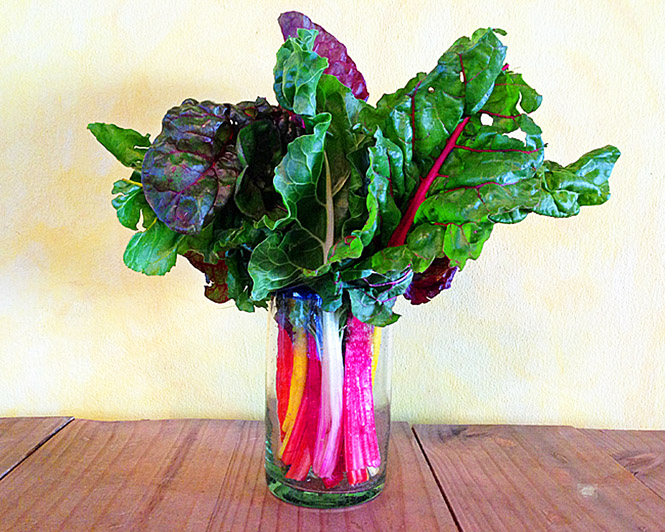
4. Glass of Chard


5. Moroccan Herbal Tea Glasses


6. Ravishing Radish Greens


7. Green and Pearl Onion Ensemble


8. Pot de Carrot 


9. Colander Couture


10. Radish-ista Fashionista

Want 10 tips for creating your own centerpiece? Then read my piece, Farm-to-Table Centerpieces for Eco-Chic Entertaining

Related Links:
Ode to a Radish